Alex Powell · 28 September 2026
Seasonal Wind Dynamics Affecting Soil Stability Across Rolling Terrain Features
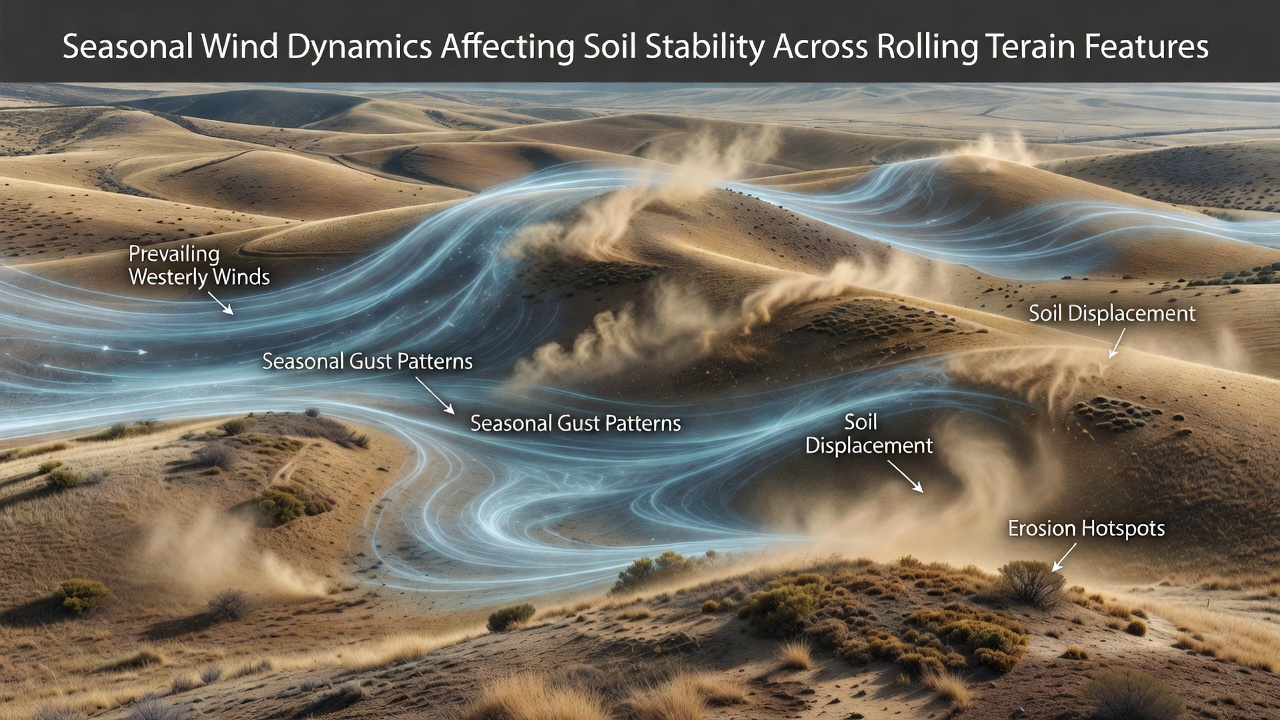
Seasonal shifts in wind patterns play a direct role in how soil holds together across landscapes marked by gentle rises and dips, and researchers track these changes through field measurements that span multiple years. Data collected from monitoring networks show that wind speeds often increase during transitional seasons while direction and duration vary with temperature gradients, which in turn influence surface drying rates and particle detachment on slopes that face prevailing winds.
Wind Pattern Variations by Season
Spring brings stronger gusts in many mid-latitude regions because temperature contrasts between land and air masses remain sharp, and these gusts align with periods when vegetation cover stays thin after winter dormancy. Measurements from weather stations indicate that sustained winds above 20 kilometers per hour occur more frequently between March and May, while soil moisture levels drop as evapotranspiration rises. Summer conditions shift toward shorter but more intense events driven by convective storms, and these events can redistribute finer particles downslope where rolling terrain creates localized acceleration zones along ridge lines.
Autumn winds tend to be steadier yet lower in peak velocity, allowing cumulative effects to build on already loosened surfaces, whereas winter brings cold, dry flows that reduce cohesion in exposed mineral soils. Observers note that these seasonal cycles repeat with measurable consistency, and records extending into September 2026 continue to confirm the same directional preferences tied to regional pressure systems.
Effects on Rolling Terrain Structures
Rolling features create zones where wind flow compresses on windward slopes and expands on leeward sides, which produces differential erosion rates that researchers quantify through sediment traps and topographic surveys. On the upslope faces, repeated abrasion removes finer fractions first, leaving coarser material that offers less resistance to subsequent flows, while depressions collect displaced particles and form small depositional fans. Studies from the United States Department of Agriculture's Natural Resources Conservation Service document how these processes accelerate when wind aligns with the long axis of a ridge system, because fetch distance increases and turbulence remains elevated for longer intervals.
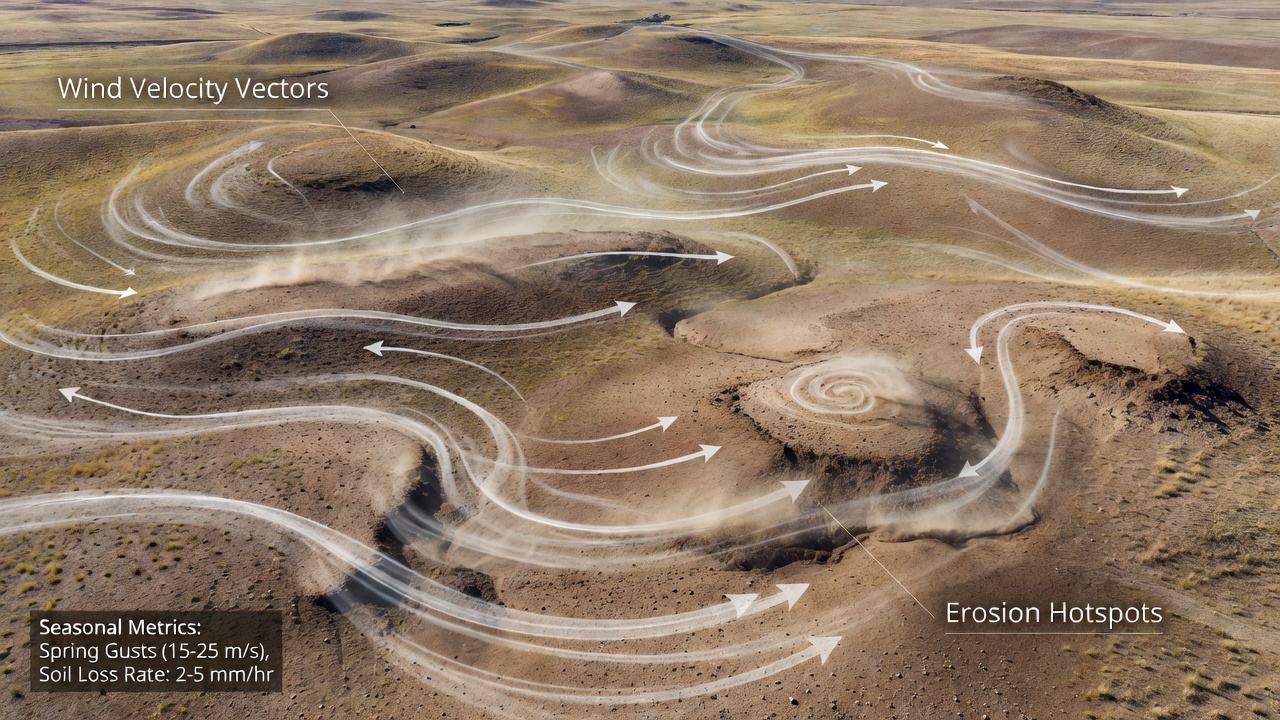
Soil stability depends on aggregate strength and root networks that bind particles, yet seasonal wind removes protective litter layers and exposes aggregates to repeated impact. Data from long-term plots reveal that stability indices drop measurably after sequences of high-wind days, particularly when those days coincide with low precipitation. In terrain where slopes range between five and fifteen degrees, the combination of gravitational pull and wind shear produces net downslope movement that accumulates over successive seasons.
Measurement Approaches and Observed Trends
Scientists employ anemometers at multiple heights along transects, paired with soil moisture sensors and erosion pins, to capture interactions between wind and surface conditions. Results from networks maintained by the Commonwealth Scientific and Industrial Research Organisation in Australia show that wind-driven losses vary with aspect, and south-facing slopes in the southern hemisphere experience greater cumulative transport during winter months when vegetation density reaches annual lows. European monitoring programs report similar patterns adjusted for local climate, confirming that terrain curvature amplifies wind effects at convex breaks in slope.
These datasets allow models to predict zones of higher vulnerability without requiring site-specific intervention in every case. Figures compiled through 2026 continue to align with earlier baselines, indicating that seasonal wind remains a consistent driver rather than an episodic one in rolling landscapes.
Interactions with Vegetation and Soil Properties
Vegetation height and density modulate wind speed near the surface, and studies demonstrate that even moderate cover reduces shear stress enough to limit particle entrainment during typical seasonal events. Root systems add tensile strength that counters both wind and gravity, yet seasonal dieback or grazing pressure can temporarily lower this contribution. Soil texture further determines response, because sandy fractions detach more readily under wind while clay-rich aggregates resist until moisture content falls below critical thresholds. Researchers have mapped these interactions across multiple terrain types and found consistent thresholds where combined wind and slope factors exceed binding capacity.
Conclusion
Seasonal wind dynamics shape soil stability on rolling terrain through repeated, measurable processes that vary with direction, speed, and surface conditions, and long-term records provide the factual basis for understanding these patterns across different regions. Continued monitoring supplies the data needed to track changes without introducing interpretive assumptions.